
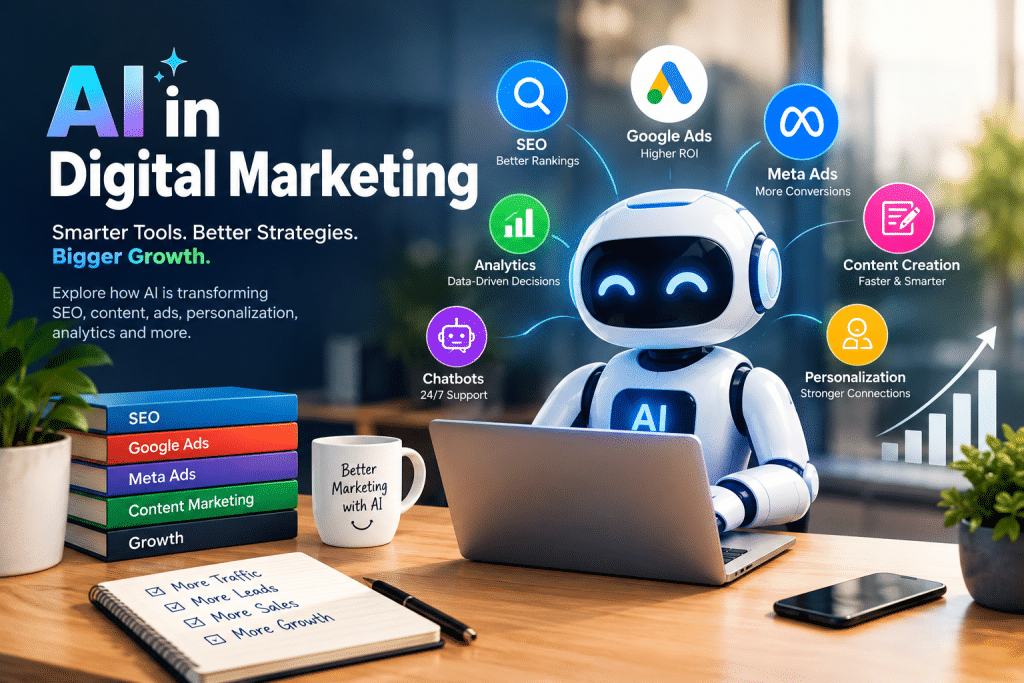
Artificial Intelligence (AI) is no longer just a futuristic technology. It has become a practical tool that is changing the way businesses attract customers, create content, run advertising campaigns, analyze data, and improve their online presence.
From generating marketing ideas in seconds to identifying potential customers and optimizing ad campaigns, AI is helping digital marketers work faster and make more data-driven decisions.
But does AI replace digital marketers?
What Is AI in Digital Marketing?
AI in digital marketing refers to using artificial intelligence technologies to analyze data, understand customer behavior, automate repetitive tasks, generate content, personalize marketing experiences, and improve campaign performance.
Traditional marketing often requires marketers to manually analyze large amounts of information. AI can process huge amounts of data much faster and identify patterns that may be difficult to spot manually.
For example, AI can help marketers answer questions such as:
- Which type of customer is most likely to purchase?
- Which advertisement is performing better?
- What topics are customers searching for?
- Which keywords can bring relevant traffic?
- What type of content should we create?
- When are customers most likely to engage?
- Which marketing channels are generating results?
This makes AI a powerful addition to the modern digital marketing toolkit.
1.Major Uses of AI in Digital Marketing
Content is at the heart of digital marketing.
Businesses need blog posts, social media captions, advertisements, email campaigns, product descriptions, landing-page copy, and video scripts.
AI tools can help marketers generate:
2.AI-Powered Content Creation
Human expertise is still important for fact-checking, brand voice, originality, storytelling, and understanding the audience.
. AI for SEO
For example, if you’re creating content around the keyword “digital marketing services,” AI can help you identify related topics such as SEO, Google Ads, Meta Ads, content marketing, conversion optimization, and local SEO.
3. AI in Google Ads and Paid Advertising
AI and machine-learning systems can help analyze this information and optimize advertising campaigns.
4. AI in Meta Ads
For example, a business may create multiple versions of an advertisement with different headlines, images, and messages.
AI-powered systems can help determine which combinations are more likely to generate desired actions.
But marketers should still test different creative concepts rather than relying entirely on automation.
A strong Meta Ads strategy combines:
5. AI-Powered Personalization
Imagine visiting an online store and seeing products that match your interests instead of random products.
That’s personalization.
AI can analyze customer behavior and help businesses deliver more relevant experiences.
For example:
E-commerce:
Recommend products based on browsing or purchasing behavior.
Email marketing:
Send content based on customer interests.
Websites:
Show relevant offers or content based on user behavior.
Advertising:
Display messages to audiences based on their interests and actions.
Personalization can make marketing communication feel more relevant to the customer.

6. AI Chatbots and Customer Support
AI-powered chatbots can help businesses communicate with customers around the clock.
They can answer common questions such as:
- What are your business hours?
- What services do you offer?
- How much does a product cost?
- How can I book an appointment?
- Where is your business located?
- What is your return policy?
For businesses receiving repetitive customer questions, chatbots can save time.
However, complex or sensitive customer issues may still require a human representative.
The ideal system is often:
7. AI for Marketing Analytics
Data is one of the most valuable assets in digital marketing.
But collecting data isn’t enough.
Marketers need to understand what the data means.
AI can help identify patterns in:
- Website traffic
- Customer behavior
- Advertising performance
- Conversion rates
- Sales data
- Social media engagement
- Customer segments
For example, imagine a company receives 10,000 website visitors but only 100 leads.
AI-assisted analysis may help marketers investigate potential reasons, such as:
- Poor landing-page experience
- Weak call-to-action
- Irrelevant traffic
- Slow website
- Incorrect targeting
- Lack of trust signals
This allows marketers to move from simply asking:
“How many people visited my website?”
Benefits of Using AI in Digital Marketing
AI can provide several advantages to businesses and marketing teams.
1. Saves Time
AI can automate repetitive tasks and speed up research, brainstorming, analysis, and content production.
2. Helps Analyze Large Amounts of Data
AI can process information much faster than manual analysis.
3. Supports Personalization
Businesses can create more relevant experiences for different customer segments.
4. Improves Productivity
Marketers can spend less time on repetitive work and more time on strategy and creativity.
5. Helps Generate Ideas
AI can provide new content angles, campaign concepts, headlines, and creative directions.
6. Supports Better Decision-Making
AI-generated insights can help marketers identify patterns and opportunities—but human judgment should remain part of the decision-making process.AI can provide several advantages to businesses and marketing teams.
1. Saves Time
AI can automate repetitive tasks and speed up research, brainstorming, analysis, and content production.
2. Helps Analyze Large Amounts of Data
AI can process information much faster than manual analysis.
3. Supports Personalization
Businesses can create more relevant experiences for different customer segments.
4. Improves Productivity
Marketers can spend less time on repetitive work and more time on strategy and creativity.
5. Helps Generate Ideas
AI can provide new content angles, campaign concepts, headlines, and creative directions.
6. Supports Better Decision-Making
AI-generated insights can help marketers identify patterns and opportunities—but human judgment should remain part of the decision-making process.
Challenges of Using AI in Digital Marketing
AI is powerful, but it isn’t perfect.
1. AI Can Make Mistakes
AI-generated information can sometimes be inaccurate or outdated.
That’s why important claims should be reviewed and verified.
2. Generic Content
If every business uses AI to create similar content, content can become repetitive.
Businesses need original experiences, expertise, examples, and opinions to stand out.
3. Lack of Human Emotion
Marketing isn’t only about data.
Storytelling, empathy, humor, cultural understanding, and emotional connection are difficult to automate completely.
4. Data Privacy
Businesses must handle customer data responsibly and follow applicable privacy and data-protection requirements.
5. Over-Automation
Automation can improve efficiency, but excessive automation can make a brand feel impersonal
How Businesses Can Use AI Effectively
“AI will do all my marketing for me.”
A better approach is:
Step 1: Define Your Marketing Goal
Are you trying to generate:
- Leads?
- Sales?
- Website traffic?
- Brand awareness?
- App downloads?
- Customer retention?
Step 2: Understand Your Audience
Define your ideal customer, their problems, interests, buying behavior, and expectations.
Step 3: Use AI for Research and Ideas
Use AI to generate ideas, analyze information, and identify opportunities.
Step 4: Add Human Expertise
Review, edit, fact-check, and improve AI-generated outputs.
Step 5: Test Everything
Don’t assume the first AI-generated idea will be the best-performing idea.
Test different:
- Headlines
- Creatives
- Offers
- Audiences
- Landing pages
- Calls-to-action
Step 6: Analyze the Results
Use campaign and customer data to understand what worked and what didn’t.
Step 7: Improve Continuously
Digital marketing is not a one-time activity.
Test → Analyze → Improve → Repeat
AI + Human Marketers: The Future of Digital Marketing
The future of digital marketing is unlikely to be simply AI vs. humans.
Instead, it will increasingly be about AI + humans.
AI can provide speed, automation, pattern recognition, and data processing.
Humans provide:
- Creativity
- Strategy
- Empathy
- Brand understanding
- Critical thinking
- Storytelling
- Business judgment
Think of AI as a powerful marketing assistant.
A marketer who knows how to ask the right questions, evaluate AI outputs, understand customers, and turn data into strategy can use AI much more effectively than someone who simply generates content and publishes it.
Final Thoughts
Artificial Intelligence is changing digital marketing—from SEO and content creation to paid advertising, personalization, analytics, and customer support.
But using AI effectively isn’t about replacing marketers.
It’s about helping marketers work smarter, move faster, and make better-informed decisions.
The businesses that benefit most from AI will not necessarily be the ones using the most AI tools.
They will be the ones that know where AI can add value, where human expertise is essential, and how to combine both effectively.
AI can generate the possibilities.
Your strategy decides what to do with them.
Frequently Asked Questions
AI can automate many repetitive marketing tasks, but digital marketing still requires strategy, creativity, customer understanding, and human judgment. AI is better viewed as a tool that supports marketers.
How is AI used in SEO?
AI can assist with keyword research, content planning, search-intent analysis, topic research, content optimization, and other SEO workflows.
Can AI create digital marketing content?
Yes. AI can assist with blog posts, social media content, ad copy, email drafts, video scripts, and other marketing materials. Human review is important for accuracy, originality, and brand voice.
How does AI improve advertising?
AI-powered advertising systems can analyze large amounts of data and help with tasks such as audience optimization, bidding, creative testing, and campaign delivery.
What is the biggest advantage of AI in digital marketing?
One major advantage is productivity: AI can help marketers perform research, analysis, content ideation, and repetitive tasks more efficiently.
What is the biggest limitation of AI marketing?
AI can produce inaccurate, generic, or contextually inappropriate outputs. Human oversight remains important, particularly for strategy, factual accuracy, brand communication, and customer relationships